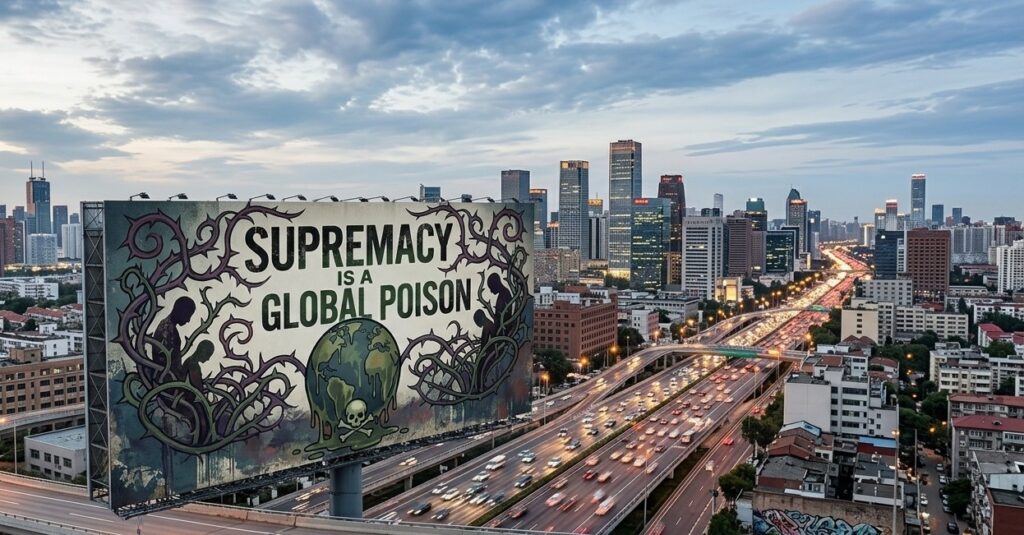
From South Africa to the Supreme Court
By Arick West
What we are witnessing right now is the clinical manifestation of a disease that has infected multiple nations simultaneously. We are watching the “drugs” of supremacy and self-loathing play out on a global stage. It’s a delusion of greatness that warps reality, and it is not an isolated American problem — it is a worldwide sickness with devastating consequences.
Look at South Africa. For decades, the apartheid regime was built on the exact same foundation of racial superiority and self-loathing that we see in America today. The white minority clung to power with an iron fist, convinced of their own greatness, while the Black majority was brutalized, disenfranchised, and pushed to the margins of society. The outcome was catastrophic — not just for the oppressed, but for the oppressors too. The economy crumbled, international isolation deepened, and the social fabric tore apart. When the regime finally fell, the damage was generational. South Africa is still recovering from the poison of supremacy injected into its institutions for over 40 years. That is what happens when a society builds itself on hate — everyone loses.
And it doesn’t stop there. We see the same patterns in China, where the Han majority has systematically marginalized Uyghurs, Tibetans, and other ethnic minorities. The same self-loathing, the same need to prop up a crumbling hierarchy by attacking those below it. We see it in India with the caste system weaponized for political gain. We see it across Europe, where rising nationalist movements echo the same tired rhetoric of racial purity and cultural superiority. The disease mutates, but the symptoms are always the same: dehumanization, institutional violence, and eventual collapse.
This brings me to a story that gives me hope. There is a Mongolian CTO — a man who came to America with nothing — who has built not one, not two, but three companies from the ground up. All three sold for millions. All three are still in business today. He didn’t have the “right” connections, the “right” skin color, or the “right” pedigree. He had vision, skill, and the willingness to outwork everyone in the room. He looked at a system that was supposedly rigged for a specific brand of “whiteness” and “greatness” and he succeeded anyway. His story is proof that the supremacy narrative is a lie — a story told by those who are terrified of being replaced by people who are simply better.
But here’s the thing: his success doesn’t erase the system. It highlights it. For every immigrant who breaks through, thousands more are held back by the same institutional barriers that have existed for centuries. The system isn’t broken — it’s working exactly as designed. And that is why we have to fix it.
This brings us to the courts. Everyone screams “pack the courts!” but that’s the wrong diagnosis. We don’t need to “pack” them; we need to fix them. The current system is a broken machine designed for political weaponization — not justice.
What would a fix look like? It would mean expanding the court to 50 or 60 justices. It would mean requiring a 30% quorum just to hear a case, and a 100% consensus to strike down a law passed by the people. It means turning the court into a school of thought rather than a partisan battleground. It means forcing the court into the sunshine — exposing every vote, every rationale, every dollar that flows through it. Until we break this concentration of power, we are just rearranging the deck chairs on a ship steered by the deluded.
The only way out is to expose the rot to the light. South Africa did it. The world watched apartheid crumble under the weight of its own contradictions. America’s version of the same disease is next. The question is whether we fix it before it fixes us.
💬 JOIN THE CONVERSATION
We’ve moved our commenting to Substack for better community discussion. No spam, no trolls — just real readers sharing real thoughts.
👉 Read this article on Substack
👉 Subscribe for early access to every post
👉 Comment & debate with the community


More Stories
The Great AI Hustle & Why Data Centers Won’t Take to the Stratosphere
The Mainframe Never Dies — It Just Gets Hijacked by Enthusiasts
The Mainframe Trap