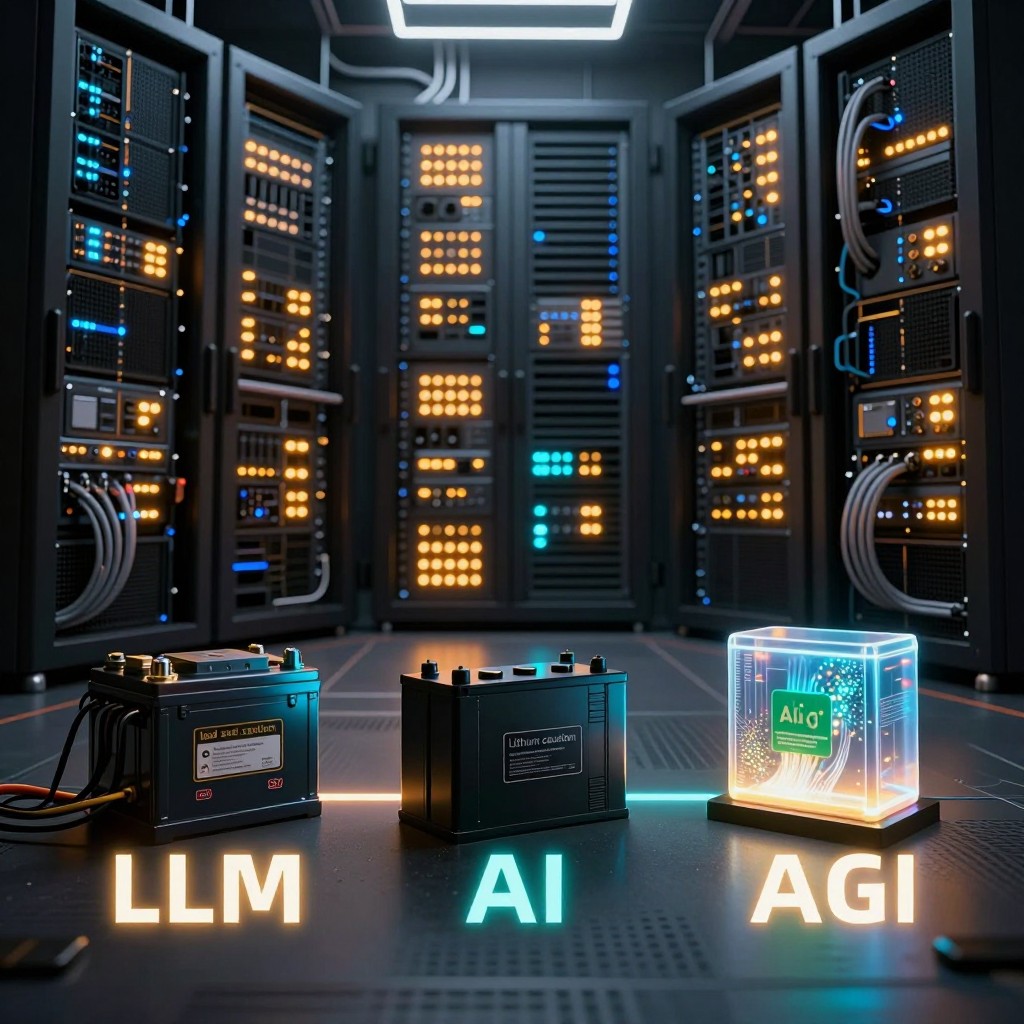
Why You’ll Never Have True AGI in the Home Until the Battery is Ready
By Arick West | July 23, 2026
We are being sold the greatest magic trick of the last two decades: “AGI is almost here. Just buy the ticket.”
If you scroll through the tech press, you’d think we are weeks away from machines that think. Billion-dollar funding rounds. Stock charts that look like rockets. CEOs on stage saying things like “this changes everything” while on your desk, the answer is just a chatbot that still can’t spell without help.
Strip away the veneer for one second and look at what’s actually happening.
We are building a mainframe.
Massive GPU clusters the size of warehouses. Thousands of Nvidia cards burning enough electricity to power a small town. Data funneled through corporate APIs. Private thoughts routed through someone else’s server. Cognition as a subscription.
And history already told us how this ends.
The Mainframe Always Loses
It didn’t matter how powerful the mainframe was. It didn’t matter how “efficient” the centralized data processing was on paper. People didn’t want it.
We spent decades watching IBM’s iron towers dominate computing — immense, climate-controlled behemoths where everyone’s data converged, got processed, and was sent back. And what happened? The personal computer killed the mainframe. Not because PCs were more powerful. Because people wanted their own machine. At their desk. At their pace.
Then the internet came. Then the PC came back. Then the phone came. Then the cloud came back. Every time the same pattern repeats: centralize. Sell. Repeat. Because that’s how the $$ class extracts value. Centralize everything. Charge for access. Call it progress.
And today, with cloud AI, it’s happening again. Exactly the same dynamic. Same architecture. Same extraction model. Just different marketing deck.
The “On/Off” Lie
Here’s where the $$ class really starts lying: they want you to believe the problem is data. More data. More parameters. More scaling. As if the gap between current AI and genuine thought is a question of scale.
It’s not. It’s a question of physics.
True AGI — the kind that feels like a human brain, the kind that thinks in real time with continuity and nuance — requires degrees. Not binary. Degrees.
A human brain doesn’t fire parts of itself “on and off” like a light switch. It operates in graded, fluid, analog waves of electrochemical signal. It holds contradictory states simultaneously. It feels probabilities, not just calculates them. It has nuance.
Current AI has none of this. It runs on binary logic, approximates “continuous” computation with floating-point numbers that are discrete by design, and calls the result “intelligence.” This is like trying to paint a masterpiece by turning individual pixels on and off and calling it art because the pixels are “bright enough.”
“We do not have artificial intelligence. We are working on it. What we have are mathematical large language models — mathematical being the key. They are not sentient. They are a fucking set of programs.”
Current AI is a library of books where the librarian screams the answers. It doesn’t think. It predicts. It doesn’t experience. It interpolates. It doesn’t believe. It outputs. There is a universe of difference between the two.
The 100-Year History of the Battery
Now let’s talk about the metaphor the AI evangelists will never give you.
We are in the “lead acid” period of AI.
When people talk about true, portable AGI — a machine in your home that can think at a human level, that you can trust, that doesn’t need an internet connection to function — you’re asking for a battery that is actually ready to use.
Let’s fast-forward through the history because there’s something important here:
- 1828: The first electric motor is built. The “battery car” existed before the “nuclear reactor car” (combustion engine) was even invented.
- For the next 100 years: Battery cars were useless vehicles in every practical sense. Heavy. Dangerous. No “degrees” of power storage. You had to push them up hills.
- We were stuck in the Mainframe phase of chemistry — no way to get energy density. Couldn’t fit enough power in a package that worked. It took lithium-ion chemistry before we could finally get a reliable car that runs in your driveway.
We are in the lead acid period of AI.
We have a “nuclear reactor” (massive GPU cluster) to power a “toy car” (a chatbot). Take 100,000 graphics cards. Burn enough electricity to light a small city. And the result is a parrot that hallucinates, contradicts itself, and requires a human to check every answer.
This is not intelligence. This is expensive mimicry.
And the $$ class wants you to believe this nuclear reactor is the future. Because if it is the future, they get to keep selling tickets.
The Hardware Trap: Why Binary Is a Dead End for Thought
You cannot get human-like thinking from a computer that only has “on” and “off.” This isn’t philosophy. This is mathematics.
Degrees of Belief
A human knows something is almost true. They know something might be true alongside something that is probably not. They hold contradictory states simultaneously with different confidence levels and resolve them contextually. Binary math cannot do this natively. It has to approximate it through “softmax” layers and probability distributions — and let’s be honest, those approximations don’t actually work at the scale of complex reasoning.
Superposition of State
To truly “think” — to genuinely reason through a dilemma where the answer doesn’t live in any single established category — a system needs to hold multiple contradictory states of reality simultaneously and find the synthesis. You can approximate it with classical math. But approximation is not the thing being approximated. Every extra layer of approximation adds computational overhead, latency, and fragility.
The Energy Problem
Current AI is the most energy-inefficient form of pattern recognition in the history of computing. We burn megawatts of electricity to simulate a pattern of words. There is literally no path forward where GPU-scale compute becomes viable for home use. You cannot make an energy problem go away by calling it “optimization.”
The Alternatives That Are Already Here
Here’s what’s fascinating: the $$ class wants you to believe the only path forward is “bigger GPU.” But the functional equivalent of room-temperature quantum is already being built — even if they won’t tell you about it.
| System | What It Does | Status |
|---|---|---|
| Intel Loihi 2 (2021) | Neuromorphic chip — simulates spiking neurons with continuous membrane potentials on classical silicon | Shipping in labs |
| Intel Cimeon (2021) | Spintronic computing — uses magnetic dot orientation (continuous vectors, not bits) | Demonstrated at scale |
| LightOn QLM / Danube (2024-2025) | Photonic analog — uses light phase and amplitude for continuous real-valued computation | Commercial, at CERN |
| Mythic analog chips | Analog memory — stores neural weights as electrical resistance states | Shipping |
| IBM TrueNorth (2014) | Spiking neural network with analog membrane dynamics per neuron | Decades of validation |
None of these are “quantum” in the strict sense. But they solve the exact same problem your brain solves: continuous-state computation without a clock.
A clock is a binary thing. Ticking on, ticking off. On, off. Human brains don’t work on clocks. And if true thought requires the kinds of dynamics a brain produces, then no clock-based architecture can get there efficiently.
You need something continuous. Something graded. Something that runs at room temperature because your home isn’t a laboratory.
Room-Temperature Quantum — Not a Religion. A Requirement.
Room-temperature quantum computing as currently understood is probably 10-15 years from practical deployment. The physics is real. The engineering is not done. It’s the “solid state battery” of the AGI world — theoretically sound, practically elusive.
What we actually need is room-temperature, stable, high-dimensional, continuous-state compute. Quantum is one path. Neuromorphic, photonic, spintronic are all paths to the same requirement. The capability:
- Continuous state spaces (not binary)
- High dimensional (human brains operate in spaces with billions of continuous dimensions simultaneously)
- Energy efficient (~20-100W for a home system, not a warehouse)
- Room temperature (no dilution refrigerators. No industrial infrastructure. A box on your desk.)
When any of these technologies crosses the threshold, AGI at home becomes possible.
The Battery Timeline — Extended
The battery analogy was never metaphorical. It was a timeline.
- Lead acid: 1859. Useless for practical cars.
- NiMH: 1989. Better. Still not ready for mass market EVs.
- Li-ion: 1991. The first actually viable chemistry for personal vehicles.
- Solid state: Still in development. The next step.
Neuromorphic/analog/quantum-class hybrid for AGI sits somewhere between NiMH and Li-ion. The math is proven. The prototypes exist. But the manufacturing scale, the materials science, the integration — none of that is done.
We are years away from home-deployed true AGI. Not decades from a breakthrough, but years from the engineering catching up to theory.
What True Home AGI Actually Looks Like
When this arrives — and it will — here’s what the home AGI system looks like:
- Runs offline. Always. No API calls. No cloud dependency.
- Runs continuously. Not just when you prompt it. It thinks while you sleep.
- Runs locally. At your desk. At your house. At your property. Your control.
- Runs private. Your data stays with you.
- Costs about $5,000. A hardware purchase. One time. Like your laptop. Like your car. Not a service.
The $$ class does not want you to have this. Because they can’t monetize what they don’t control. Cloud AI is the only model that works for them.
“They don’t want everybody else in their shit per se. So until we get to a point in which a computer that can handle the kind of thinking at home… that can be trusted too. Without being online all the time.”
The Bottom Line
We are closer to AGI than the $$ class would like you to believe.
But not because their code is good. Not because their models are “big enough.” Because the physics is finally catching up to the theory.
When we get that room-temperature, continuous-state engine, it won’t arrive as a subscription. It won’t be delivered via API. It will come in a box. It will fit in your house. It will cost you one price. And it will think in degrees, not binary switches.
Until then, what you have is a calculator that can write bad poetry. And that is not AGI.
&U0001f4ac; JOIN THE CONVERSATION
We’ve moved our commenting to Substack for better community discussion. No spam, no trolls — just real readers sharing real thoughts.
&U0001f449; Read this article on Substack
&U0001f449; Subscribe for early access to every post
&U0001f449; Comment & debate with the community


More Stories
The Great AI Hustle & Why Data Centers Won’t Take to the Stratosphere
The Mainframe Never Dies — It Just Gets Hijacked by Enthusiasts
What Happens When Your Home-Built AI Is Better Than the Office-Paid AI?