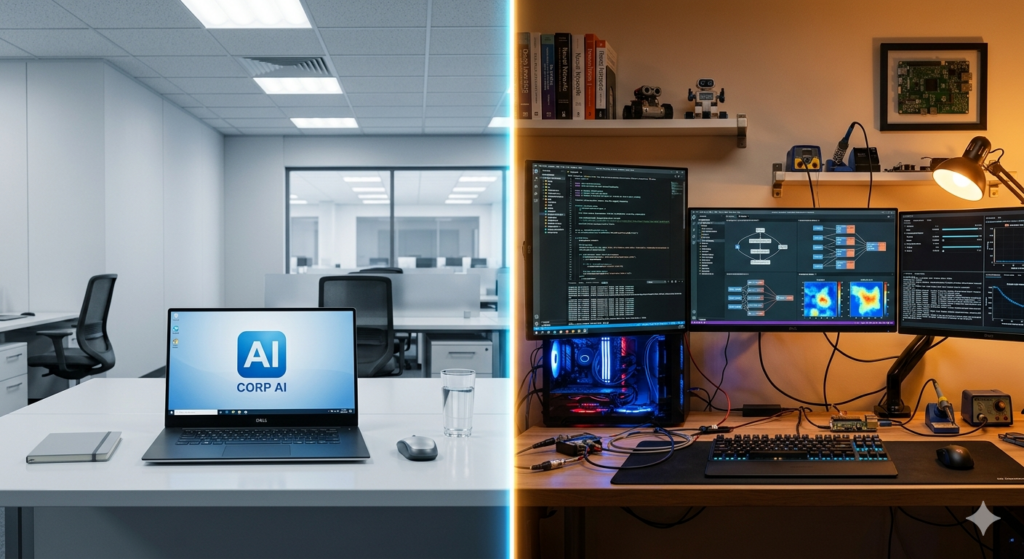
What Happens When Your Home-Built AI Is Better Than the Office-Paid AI?
By Arick West | Published: June 24, 2026
You know that feeling when your company spends thousands on a corporate AI tool, promises you “the future of productivity,” and what you get is a glorified autocorrect with delusions of grandeur?
That’s Copilot at most offices right now. It’s the corporate equivalent of the IT department installing software without asking what anyone actually does all day.
I’m sitting here with my home-built AI setup and the contrast is… illuminating.
The Office Setup: Corporate AI Theater
Most companies approached AI the way they approached everything else in the 2010s: vendor lock-in, compliance frameworks, and budget cycles disguised as innovation. You get:
- A subscription to something that costs more than any reasonable alternative because the procurement team can’t justify a $0 tool
- Data residency concerns that actually just mean your company’s data is stored in a server where anyone with admin access can theoretically see it (ironic, given you’re letting the AI see your email)
- A model that was fine-tuned for “enterprise safety” which the marketing team translates to “it can’t do anything interesting”
- Integration requirements that somehow always mean your AI lives in a separate app you have to context-switch to instead of where the work already happens
The irony? The company pays a premium for the branding of “cutting-edge AI” while using a tool that’s objectively worse at the actual work than the free alternative anyone can run on their own hardware.
The Home Setup: What Actually Works
Meanwhile, your home setup doesn’t have any of those constraints. There is no compliance committee. There’s no procurement cycle. There’s just you and the hardware.
You get to:
- Run models locally on hardware that cost you less than the annual corporate subscription. That GeForce card from 2023? It’s running something the office setup from 2025 still can’t touch.
- Choose the model for capability, not for “enterprise security” (whatever that means when your laptop already has your passwords, tax returns, and private photos)
- Fine-tune on your own writing style, your own domain knowledge, your own voice — the stuff the corporate tool has no access to and no incentive to learn
- Ask it to do weird things it wasn’t designed for — because it’s yours. There’s no feature request queue. You just build it.
The Tipping Point Is Here
We’re watching a structural shift that most people in the tech industry don’t want to talk about because it undoes their business model.
Billing model arbitrage is the key phrase here. Home AI is being billed by:
- The upfront cost of hardware (one time)
- Electricity (which was already being paid)
- Time (which was already being spent)
Office AI is billed by:
- Per-seat subscription ($20-$100/month per person)
- Usage tiers (because of course there are tiers)
- Vendor lock-in (because switching costs are designed to be painful)
When your NUC or Jetson at home can run models that were literally designed as “better than GPT-3.5” and you can spin up a new one over a weekend while your company takes 6 months to approve the Copilot upgrade, the math stops working for the vendor model.
What Happens Next
Here’s what I predict, based on what’s already happening:
The Great AI Exodus — People at companies will quietly keep using their home setups and tell themselves they’re “testing the corporate tool.” This is how it always starts. The IT department calls it “shadow IT” the day anyone asks about it.
Corporate AI becomes a presentation tool — The models in the office will be fine for making decks, drafting standard emails, and looking innovative at board meetings. The actual hard work? Done on personal hardware by the people who know what they’re doing.
The privacy paradox collapses — Companies will realize they’ve been asking employees to upload sensitive data to vendor clouds while those same employees have better-secured setups (because they actually control them) on their own machines. The irony will be that employees are more private and more productive on their own devices than on their company’s “secure” AI.
Vendor lock-in becomes vendor avoidance — When the best models are open and run fine at home, the entire SaaS AI business model looks like what it is: a rent-seeking layer on top of free technology.
The Real Issue
The office isn’t failing because AI doesn’t work. The office is failing because the people who understand AI built it for themselves, not for the company. Your home setup isn’t better because AI is inherently superior at home. Your home setup is better because:
- It was built with actual needs as the design constraint, not vendor feature roadmaps
- Performance was the only budget — and home builders know that the best value is always just outside the “recommended” tier
- There is no user interface for approval — you just do it. You don’t need a committee to make it work.
Bottom Line
When the company-paid AI is objectively worse than the free AI you built yourself, you have two choices:
- Keep paying for the corporate tool because “the boss thinks it’s innovative”
- Acknowledge that the tools that make you better at your job live on your own hardware and stop apologizing for using them
I’ve already made my choice. And here’s the thing no corporate AI company wants you to realize:
“There is no going back. Once you’ve used a tool that actually works, the corporate alternative doesn’t look like innovation. It looks like what it is — a middleman selling you back technology that should’ve been free the whole time.”
The home-built future of AI isn’t coming. It’s already here. It just doesn’t have a subscription page yet.
JOIN THE CONVERSATION
We’ve moved our commenting to Substack for better community discussion. No spam, no trolls — just real readers sharing real thoughts.
👉 Read this article on Substack
👉 Subscribe for early access to every post
👉 Comment & debate with the community


More Stories
The Great AI Hustle & Why Data Centers Won’t Take to the Stratosphere
The Mainframe Never Dies — It Just Gets Hijacked by Enthusiasts
The Mainframe Trap