And Why SpaceX’s IPO Collapse Proves It
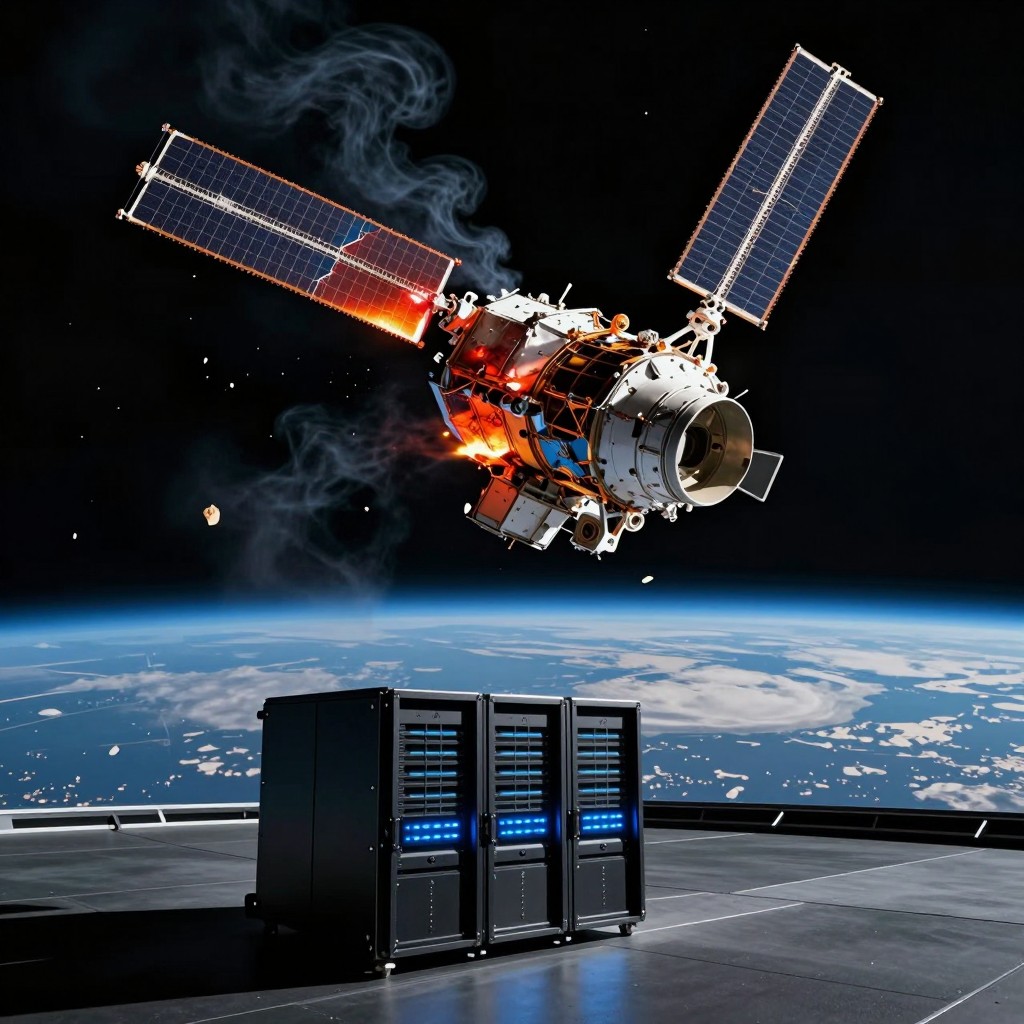
The orbital AI server concept has a seductive simplicity: launch GPUs into space, power them with solar arrays, and process AI workloads above the interference of Earth’s atmosphere. SpaceX itself flirted with the idea. SpaceX AI-0, launched in April 2025, carried two RTX 5090 GPUs into orbit as a test. A follow-on spacecraft, SpaceX AI1, was planned with 150 kW peak power, a ~600 square meter solar array, and roughly one GB300 equivalent per satellite at ~$100 million per unit. Google’s Suncatcher program, Blue Origin’s Sunrise concept, and Axiom’s ODC were discussed in the same breath.
The physics does not support the pitch:
- Thermal rejection: In space, there is no air or water for cooling. Radiators reject heat by radiation alone, governed by the Stefan-Boltzmann law. A 100 kW heat load requires a radiator surface area of roughly 400–500 square meters — a huge fraction of the total satellite bus. That’s a massive, fragile, and expensive thermal management system.
- Radiation: Space radiation (cosmic rays, solar particle events) corrupts volatile memory, flips bits in silicon, and degrades electronic components over time. Consumer-grade RTX GPUs and standard data center hardware are not radiation-hardened. Single-event upsets would cause frequent GPU and memory errors.
- Interconnect bandwidth: Axiom’s ODC demonstrated 2.5 Gbps inter-satellite links. NVLink in a ground-based DGX node operates at ~1.8 Tbps. The ground-based interconnect is roughly 720,000 times faster. You cannot stitch together 123 GPUs in orbit when the wiring between them is a billion times slower than a cabinet on Earth.
- Launch cost at ~$2,000+/kg: At a $100 million satellite with ~1 server equivalent, the economics collapse immediately. A single ground-based hyperscale rack costs roughly $4–6 million and houses dozens of GPUs under reliable, maintainable conditions.
The orbital concept isn’t even a data center — it’s a satellite with one GPU. The marketing claims of 123 GPUs per satellite were not borne out by any hardware design. One server per $100 million satellite is not a competitive offering.
But the deeper problem isn’t physics — it’s economics. And SpaceX’s IPO, which collapsed in 45 days, proves why.
The SpaceX IPO: The IPO That Proved Everyone Wrong
On June 12, 2026, SpaceX closed the largest IPO in history — $1.77 trillion valuation, $75 billion raised, $135 per share, on the Nasdaq under the ticker SPCX. The retail demand was unprecedented: 30% of allocation went to retail accounts (3–6x normal oversubscription). Only ~5% of shares had a public float. 44% of shares are held by insiders.
What happened next? The stock dropped 25% within six weeks and fell *below* its $135 IPO price for the first time on July 15, 2026.
Here’s why the collapse matters for the AI infrastructure debate:
1. The $14 Billion AI Cash Burn Nobody Saw Coming
The S-1 filing revealed SpaceX’s AI unit (xAI, acquired in the February 2026 merger) spent $12.7 billion on capex in calendar 2025 and another $7.7 billion in Q1 2026 alone. For Q1 2026, SpaceX reported a $4.276 billion *net* loss — one quarter, one company. The AI segment posted a $6.355 billion operating loss in 2025 before even accounting for Q1 2026.
SpaceX’s “space AI servers” required $20.4 billion in AI capital expenditure across 2025 and Q1 2026. That’s the exact figure that made the orbital server concept — $100 million per satellite, one GPU per satellite — look like a joke.
2. The $60B Cursor AI Acquisition
In June 2026, just two weeks post-IPO, SpaceX announced a $60 billion acquisition of AI coding startup Cursor. This was widely viewed by analysts as the final sign that SpaceX CEO Elon Musk was prioritizing AI platform consolidation over any core business capability. The acquisition wiped out $600 billion in market value the day it was announced.
3. $20 Billion in Bonds Trading at Junk Levels
Post-IPO, SpaceX issued $20 billion in bonds. Bloomberg reported that “traders couldn’t recall another deal where prices sank that quickly.” SpaceX bonds moved from investment-grade ratings (Baa1/BBB+/BBB) to near-junk territory within three weeks. The Wall Street consensus, per NYU Stern professor Aswath Damodaran, was that the IPO valuation was “embarrassingly overvalued” — the prospectus “was written by Grok” — and the $28.5 trillion TAM estimate was a “hallucination.”
4. Lock-Up Cliff and Insider Dump Ahead
With 44% of shares in insider hands and the lock-up expiring in September 2026, the potential for a forced sell-off is enormous. CFRA analysts project another 23% decline. GMO’s Jeremy Grantham called the IPO “possibly the craziest in human history.” Paul Krugman compared it to a Ponzi scheme.
What This Means for the AI Infrastructure Debate
SpaceX’s collapse is not just about one company. It illustrates a structural reality that is *worse* for orbital AI servers than for ground-based ones:
- When valuations are built on $28.5 trillion TAM (“written by Grok”) rather than cash flow, *every* capital-intensive venture gets overfunded and *every* failure hits retail investors hardest. SpaceX burned ~$30 billion in cash across the four quarters ending Q1 2026. At current burn, the entire $75 billion IPO raise is gone in roughly 2.5 years.
- When AI capex outpaces revenue by 10-to-1 (xAI: $20.4B capex vs. Starlink: $11.4B in *total* revenue), the “AI platform plays” that promise to conquer space are the riskiest of all. Orbital AI servers were the most capital-intensive subset of all of them, and SpaceX already collapsed under the AI capex weight *without* the added thermal, radiation, and interconnect challenges of orbit.
- Private-company valuations don’t survive public scrutiny. Before the IPO, SpaceX could claim it was “just getting started” with orbital compute for years without anyone demanding proof. After going public, the $1.8 trillion price tag was held to the same math as every other public company: revenue multiples, cash flow, and P/E ratios. The gap between story and reality opened a chasm, and the stock fell through it in 45 days.
The ground-based reality:
- Ground data centers *work*. NVIDIA’s H100/A100 clusters in purpose-built facilities achieve 99.97% uptime.
- Ground AI capex is real, but it’s *also* real revenue-generating capacity. SpaceX burned $20.4B on AI capex and produced nothing. Ground data centers produce inference and training capacity on a known return curve.
- The SpaceX collapse *accelerates* the thesis: companies that *actually deliver* AI compute at useful scale will be the survivors. Not orbital satellites with one GPU each.
Why Local and Corporate AI Will Win
The SpaceX collapse reinforces three structural advantages that ground-based, home, and corporate AI systems hold over any orbital alternative:
1. IP Protection
Every major corporation with AI workloads knows exactly what happened with SpaceX, and no CISO will allow their proprietary models, trading algorithms, or R&D data to be processed on infrastructure that orbits over potentially adversarial jurisdictions. The S-1 revealed that SpaceX’s AI spend was $20.4 billion — much of it for models that are, by definition, proprietary intellectual property. You do not send that to space.
Space-based processing would require data to be transmitted to orbital servers and data returned — a latency and bandwidth nightmare compounded by the risk of data interception or tampering in transit through uncontrolled airspace. Corporate IP is worth billions per model. Moving it through orbital infrastructure is an unacceptable risk.
2. Privacy and Regulatory Compliance
Healthcare (HIPAA), finance (SEC, FINRA), defense, and government AI systems all require data sovereignty, auditability, and physical security controls that orbital servers cannot provide. No regulator in any jurisdiction accepts “your data orbited over the Atlantic” as a compliance posture.
The SpaceX collapse — and the revelation of its $60B Cursor acquisition and $20.4B AI capex — demonstrates that even the most powerful corporate players cannot protect their IP when the business model is unstable and the infrastructure is unproven.
3. Latency and Real-Time Processing
At the speed of light, a signal from Earth to GEO orbit and back takes a minimum of ~48 milliseconds. That is 48ms of pure propagation delay for *every* inference. On a ground-based cluster, network latency between servers is measured in *microseconds*. For AI workloads requiring inter-GPU communication (LLM inference, real-time training, robotics), the interconnect advantage of ground is insurmountable. NVLink at 1.8 Tbps vs. 2.5 Gbps inter-satellite links isn’t a marginally better choice — it’s a fundamentally different computational paradigm.
4. Home AI: The Personal Data Moat
At the consumer level, AI is moving *to* the home, not away from it. Smart speakers, home assistants, local LLMs running on consumer hardware (Mac minis, GPUs in the rack) — these devices have access to personal data that no cloud provider can see. Your home AI knows your schedule, your health metrics, your financial patterns, and your communication habits. You own that data. It never leaves your network.
SpaceX tried to sell orbital AI as the future. Apple, Google, and Microsoft are building on-device AI. The market is voting with its wallet: consumers want their AI to stay with them, and corporations want their AI to stay on their premise.
The Bottom Line
The orbital AI server concept fails on physics, economics, and now, credibility. SpaceX’s $1.77T IPO, which promised to revolutionize AI computing from orbit, collapsed within six weeks because the $20.4 billion in AI capex produced nothing tangible, and the $100 million per satellite “one GPU” reality is not a scalable data center — it’s a space experiment.
Meanwhile, local and corporate AI is winning because that’s where the data lives, where the IP needs to stay, where the latency requirements are, and where the privacy regulations demand. The compute doesn’t need to go to space. The data is staying on the ground, and that’s exactly where it should be.
SpaceX’s collapse is not a setback for AI. It’s a correction. The orbital AI servers concept is already overvalued at zero.
—
*Sources: SpaceX S-1 filing (SEC), Forbes (Peter Cohan, July 10; Tyler Roush, July 15; Erik Sherman, June 23), Morningstar (May 22), NYT, Bloomberg, CNBC, Truist analysts, CFRA, GMO (Grantham), NYU Stern (Damodaran), Paul Krugman, MarketBeat consensus targets.*
💬 JOIN THE CONVERSATION
We’ve moved our commenting to Substack for better community discussion. No spam, no trolls — just real readers sharing real thoughts.
👇 Read this article on Substack
👇 Subscribe for early access to every post
👇 Comment & debate with the community
© July Arick West — noitisnotjustyou.com
More Stories
The Mainframe Never Dies — It Just Gets Hijacked by Enthusiasts
The Mainframe Trap
What Happens When Your Home-Built AI Is Better Than the Office-Paid AI?